


Tires & Safety (Bus/Vanagon/Eurovan)
 Please specify your vehicle here.
Note: We are no longer carrying tires at this time,
but have left this page up for informational purposes.
Most passenger car tires are dangerous
to use on your VW van. Here's why.
Bus, Vanagon, and Eurovan Tire F.A.Q....
"What are the tire requrements for Busses, Vanagons, and Eurovans?"
"Why can standard passenger tires be dangerous on these vans?" "
Are passenger car tires safe if I upgrade to 15" or 16" wheels?"
"Why are many "correctly rated" tires still poor choices for these vans?"
"What are the tire requirements for Busses, Vanagons, and Eurovans? Why can't I use standard passenger car tires?"
The VW Bus, Vanagon, and Eurovan have unusual tire requirements because they are very heavy vehicles sitting on comparatively small tires. While most modern vans and SUV's use 16 to 18 inch tires (which can handle more weight), most VW vans use much smaller tires. This puts more strain on the tire's sidewall and therefore requires a tire especially designed to handle this. Most passenger car tires are simply not designed to handle the weight of a VW van, and do not meet VW's specs for safe use on a VW bus or van.
Starting in the mid 1960's with split-window busses using 14" tires, and continuing through the Eurovan, Volkswagen specifically required that the tires have specially reinforced sidewalls, designed to handle the heavy load of the vehicle. These special "sidewall reinforced" tires were supplied with your VW Bus or Van when sold new, and the warnings on the door jamb and in the manual clearly advised that only similar replacement tires be used, for safety's sake.
Standard-load passenger car tires are simply unsafe for use on VW vans. This is agreed upon by both Volkswagen and the U.S. Department of Transportation. According to U.S. D.O.T. tire safety standards, a Light Truck tire used on a VW bus or van (which is classified as a light truck for tire purposes) must be able to handle 6% above the van's maximum load capacity. But if the tire is a P-rated (passenger car) tire, its load capacity specification must FIRST be reduced by 9% to determine its Light Truck load capacity (again, as per the U.S. D.O.T.), and then the 6% safety margin deducted from that number. If you do the math, based on the GAWR (Gross Axle Weight Rating) of a Bus or Vanagon you get the following minimum acceptable load ratings: 1520 lbs (load index 95) for a light truck rated tire, or 1670 lbs (load index 99) for a standard Passenger car (P) rated tire. For a Eurovan, Volkswagen recommends more stringent guidelines, advising a minimum load index of 100 (1764 lbs).
Then the tire must handle the recommended inflation for your VW van. This is especially an issue with Busses and Vanagons, which require unusually high rear-tire inflation on most years (as high as 53 psi, depending on the year and the tire size). See the inflation requirement noted on your door jamb or owners manual, and compare that to the maximum inflation rating on the tire's sidewall. If the tire's rating is lower, it cannot be properly inflated when used on your van.
So for safe use on a VW van, both the tire's load capacity and its inflation capacity must exceed those required for your van (as noted above). This rules out virtually every standard-load passenger car tire on the market - which is precisely why Volkswagen themselves say not to use them. Look for the terms "Sidewall Reinforced," "Load Range C", or "Load Range D" on the tire. Most tires that carry those designations will have sufficient sidewall strength for safe use on a VW bus or van, but you should still check the exact specs to make sure.
These specs can only be used to rule out tires that are unsafe for your van under any conditions. They cannot be used to rate the quality of the tire. Among those tires that do meet these specs, there are still huge differences in handling, traction, comfort, and reliability, just as with any tires. More on this later.
"What's the worst that could happen if I use standard passenger car tires anyway?"
 It's not always easy to find appropriately rated VW Bus and Vanagon tires, and in some places they are quite expensive. So many people "cut corners" and put passenger car tires on their VW vans. Even some over-eager or inexperienced tire store salespeople will claim that a passenger car tire "will do just fine" because they simply don't have the correct tire that you need or don't want to order it. This is easy for the salesman to say, when he won't be the one whose life is riding on those tires.
The truth is, using an insufficiently rated tire on your van could literally kill you.
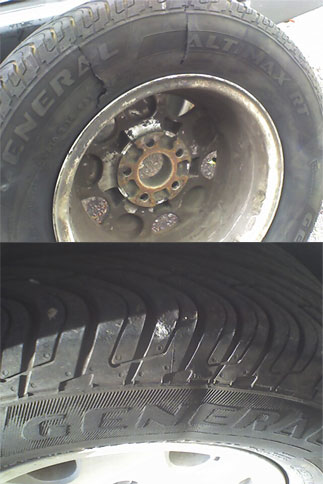
A picture tells a thousand words. Take a look at the ones on the right. They're from a customer who decided to save a few bucks, and replaced his worn but correct LT rated tires with just-barely-below-spec passenger car tires (rated at 98T). He agreed to let us post them here to warn others about his experience.
Right off the bat, he writes, 'I felt a sort of wallowing 'marshmallow' feel while driving through corners or in sidewinds" that hadn't been there with the old, correct tires. This is a strong indication that the sidewall is flexing due to the Bus, Vanagon, or Eurovan's weight. But you may or may not notice it. Some underrated tires will exhibit this effect more than others, and some drivers notice it more than others. Many drivers don't notice it at all because, having never had the correct tires, they think their van is supposed to handle like that. (They are often utterly amazed when they switch to the right tires and discover what their VW was capable of all along!)
Within a few thousand miles, not just one but two of his tires had developed visible signs of sidewall failure (see upper picture on right). Fortunately these occurred on the outside sidewalls, so he noticed them. If they had happened on the inner sidewalls, he wouldn't have noticed them until the next time he found himself lying under his Vanagon. He realized he had a problem, but before he even had a chance to go back to the tire dealer, one of his tires blew out on the highway. The sidewall that blew out wasn't even one of the two he'd already noticed, but a third one. The lower picture on the right shows what it looked like after the tire blew. Fortunately it happened to be a rear tire that blew out. Had it been a front tire, and/or had it occurred in the rain or under other adverse road conditions, he might have rolled his Vanagon and been killed.
We'd like to stress that this is not a criticism of the particular brand of tire pictured. This is not the tire's fault. It is most certainly a fine and perfectly safe tire... when used on a vehicle that it is meant for. No tire can be expected to be safe or reliable if you put it on a vehicle that the tire manufacturer, the vehicle manufacturer, and the National Highway Safety Administration all agree is too heavy for the tire. That's what the ratings are for!
But there's a second issue, too. Even if we ignore the sidewall issue entirely, according to the AAA underinflation is the leading cause of accidents due to tire failure. It also reduces performance, causes the tires to wear out prematurely, and reduces gas mileage (which can be costly, at today's fuel prices). If you use a passenger car tire on your VW van, you will be forced to underinflate it, because its maximum safe inflation capacity (which is stated on the sidewall) will almost certainly be too low for your vehicle (as specified on the door jamb, fuel filler flap, or owners manual). This forces you to keep your tires underinflated all the time ... dramatically increasing your risk of accident, according to the AAA and others.
Will every underrated tire fail catastrophically within a few thousand miles? No. People go thousands of miles on the wrong tires without a blowout ... which creates a false sense of security, particularly if they don't notice the ride difference. But you may be just one panic swerve away from a nightmare that could change (or end) your life. The sudden changes in direction that may occur if you are taking evasive maneuvers - avoiding an accident - put an inordinate amount of weight on a single tire. If that tire is underrated to begin with, but just managing to hang on during normal driving, the sudden shift of extra weight to its sidewall can easily be the "straw that breaks the camel's back." At the very moment when you most need your tire's stability to avoid the accident, it can flex badly enough to cause you to lose control of your van, or blow out, or suffer bead separation (which means that the sidewall flexes so much that the tire literally pops off of the rim). A blowout can be hard to control even under normal driving. If it happens at the very second that you are already swerving to avoid an accident, the results can be deadly.
Using a underrated tire, just like not wearing your seat belt, is playing a game of Russian roulette. All it takes is one time. The next time you get behind the wheel could be the one time when the seat belt, or the properly rated tire, would have saved your life. Tire safety is not a place to take chances and cut corners. A correct tire doesn't cost much more than an incorrect one; in fact, the price difference for 4 tires combined is hardly more than the cost of a tank of gas. Is it really worth risking your life, and those of your passengers and loved ones, to save a couple of bucks?
"Can I safely use standard passenger car tires if I upgrade to 15" or 16" wheels and tires?"
No, despite what some retailers would have you believe. Volkswagen's own engineers have been very clear about this, throughout the entire history of the VW van. Several versions of VW vans, from the 60's through the present-day T5 (the successor to the Eurovan, not sold in the U.S.) have come factory-equipped with 15" or 16" wheels. As tire sizes have increased and tire technology has improved, Volkswagen has indeed tinkered with some specs such as recommended inflation. But never - not once, not even on the brand new VW vans sold today in Germany with 16" tires and the latest tire technology - have they wavered on the requirement for extra-load tires. If using a 15" or 16" tire meant that reinforced tires were unnecessary, Volkswagen would have stopped using them long ago. Car manufacturers love to cut costs. Volkswagen could have saved a fortune over the last decade by factory-equipping their vans with standard-load tires once the wheel sizes hit 15" or 16"... had they felt it was safe.
"So does this mean that any tire that meets the above specs is okay for me to buy?"
No. It just means that the tire meets the minimum acceptable specs. There are still better and worse tires. You will also want to consider these factors:
Tire Size. All things being equal, a narrower tire will have better traction in bad weather (rain, snow, or ice) and be less prone to hydroplaning. A wider tire will have better dry-weather traction, but at the expense of bad weather traction. So when considering between two equal tires of different widths, consider under which conditions you want your vehicle to be more sure-footed. (Of course the difference may be minimal if you are comparing two very close sizes.) As for tire height versus wheel size, a smaller wheel with a taller tire will have a less bumpy ride and be less prone to pothole damage. If you use a larger wheel with a lower profile tire, you are replacing tire sidewall (which has some "give") with metal wheel (which doesn't), so the ride will be slightly harder. Of course there is the option to go with both a larger wheel and a taller tire, provided that it will clear your wheel wells and will not make the van too tall for garages. However do note that this will change the reading of your speedometer, since the tire will have fewer revolutions per mile.
Tread design. Some extra-load tires have an aggressive tread pattern that may be good for use on an SUV if you're off-roading, but can produce irritating "road hum" when driven on the highway. Others hydroplane easily on wet roads, or slip easily on snow and ice. If you live in an area that that gets any winter weather at all, and plan to use the same tires year-round, only buy tires that are labeled M&S on the sidewall. That designation means that the tire has been rated "all season" by the Rubber Manufacturers Association of America. An all-season tire is not as good on snow and ice as an actual snow tire of comparable specs and quality, but at least it is designed with that capability in mind. If the tire does not have M&S labeling (or a snowflake) on the sidewall, it is a summer-only tire which should never be driven in winter weather at all. Conversely, an actual snow tire should not be used in the summer, as its rubber compound is not designed for hot asphalt and this can affect both handling and lifespan.
"Truck-like" ride. The original tire that VW used on the Bus, Vanagon, and Eurovan was not a truck tire, but a specially designed passenger car tire with a higher load rating. However, many currently available tires that meet VW van specs were actually designed for use on delivery trucks. While they may be safe for use on VW vans, many of them sure aren't comfortable. They make your VW drive like a delivery truck, with a bumpy, noisy "truck-like" ride.
Price. Some tires that do meet VW specs and handle well are very expensive.
Off-Brand and Counterfeit Tires. Many of the off-brand Chinese tires that have flooded the market are one-shot deals from fly-by-night companies. An importer buys a container of tires, blows them out cheap to various tire distributors, and then moves on to some other product or tire. There is no accountability and no actual tire company in the U.S. to speak to if there is a problem. Even if the sidewall data is accurate, good luck finding a matching tire a year later if one blows out, or finding an actual company to honor the "warranty" if the tire is defective. (One tire importer went out of business not long ago because all of their Chinese made tires were recalled and they did not have the finances to support the recall.) Consumer Reports recently weighed in on the issue when they road-tested several name brand tires against Chinese knockoffs that were purported to use similar technology or had similar looking tread. They reported not only that the knock-offs didn't handle as safely, but that they didn't even save money because they wore out so much faster.
But it gets worse. Consumer Reports recently found Chinese made tires that had falsified markings on the sidewalls - not just the brand name but apparently the D.O.T. data as well (which may include anything from age and factory name to traction and load rating). They were purchased from a large online tire retailer. The only reason it was discovered is that when Consumer Reports rated the tire poorly, the brand (who sells Chinese tires under their name) contacted them for details. When CR read them the sidewall markings, it turned out they were counterfeit. Nobody knows how common this is, because nobody is checking. An unscrupulous company can put anything on the sidewall of a tire because no government entity actually confirms the data when the tire is imported. Your best protection against this is to stick with well regarded and established tire brands that have a reputation to protect.
Quality. Even among known brands, there are large differences in quality. Remember that most tire retailers have no experience with these relatively rare tires. They can read the specs, but they have no real-world knowledge. They don't know which ones handle well on our vans, which are a bad match for our vans' unique handling characteristics, and which have known quality issues. Consider the following reports taken from the Type 2, Vanagon, and Eurovan mailing lists:
'"This [well known tire from a major German brand] is a common tire on the Eurovans (and is also sold for busses and Vanagons). My opinion is that they should be outlawed. Horrible in the rain, prone to belt shifting and tread separation. As for the ride, remember kiddy bicycles with the solid tires? And don't even think of using them in snow."
"If you're looking for a very aggressive reinforced sidewall snow, these [expensive snow tires] are them; however I'd think long and hard again before buying them, as I think they are almost too aggressive for day-to-day driving."
"My [tires from the leading U.S. brand] lasted forever, but what a horrible ride. And they were like bicycle tires in the snow."
"I spent the summer driving and taking care of 15-passenger vans on rough gravel roads in rural Alaska. The vans had a variety of different brands of tires, including [a brand sold by a major warehouse club, rated as suitable for Busses and Vanagons]. They were by FAR the worst of all the brands we had on our vans. They typically had to be replaced due to tread separation, and this would take place LONG before they should have been "used up." If one of them encountered a rock or a pothole - a trivial event for most tires - it would spring multiple pinhole leaks in the area of the impact."
The conclusion? Immediately rule out any tire that doesn't meet the minimum safe specs for use on your Bus, Vanagon, or Eurovan, as outlined above. Then choose wisely among the ones that do, remembering that those are only minimum standards. Is the tire well regarded? Is it well suited for your comfort, driving style, and climate? Don't pay more than you have to, but stick with a quality tire. After all, there's a lot riding on it.